Chain of custody embryo shipping comes down to one question: can anyone prove, minute by minute, where the embryos were and whose hands they were in? A record that answers yes protects everyone involved. A record with gaps protects no one.
For clinics choosing a transport partner, this is the most useful thing to evaluate. It is also the thing vague providers are least eager to show.
What Is Chain of Custody in Embryo Transport?
Chain of custody in embryo transport is the continuous, signed record of who held the embryos, where they were, and at what temperature, from the moment they leave the origin clinic until the destination clinic accepts them. Each transfer of responsibility is documented as it happens. If one link is missing, the record cannot prove what occurred in that interval.
The record carries two kinds of evidence. Custody evidence covers people, times, places and signatures. Condition evidence covers temperature data and seal integrity. Either one alone leaves a question open. Together they close it.
Why Chain of Custody Is Not Bureaucracy: What the Record Protects
The record is the only evidence that exists after the trip is over. Embryos cannot testify, and memory fades quickly. Paper and logger data are what remain. It protects the clinic. A complete record shows that the laboratory followed its own protocol at loading and at receipt. If a question arises weeks later, the lab answers it with documents instead of recollection. It protects the patient. The people most affected by a transport are the ones who see least of it. The record is their assurance that someone was accountable at every step. It protects traceability. If anything is questioned, a clear record narrows the search to a specific interval and a specific person. A thin record widens it to the entire trip.
What Should Be Recorded at Collection?
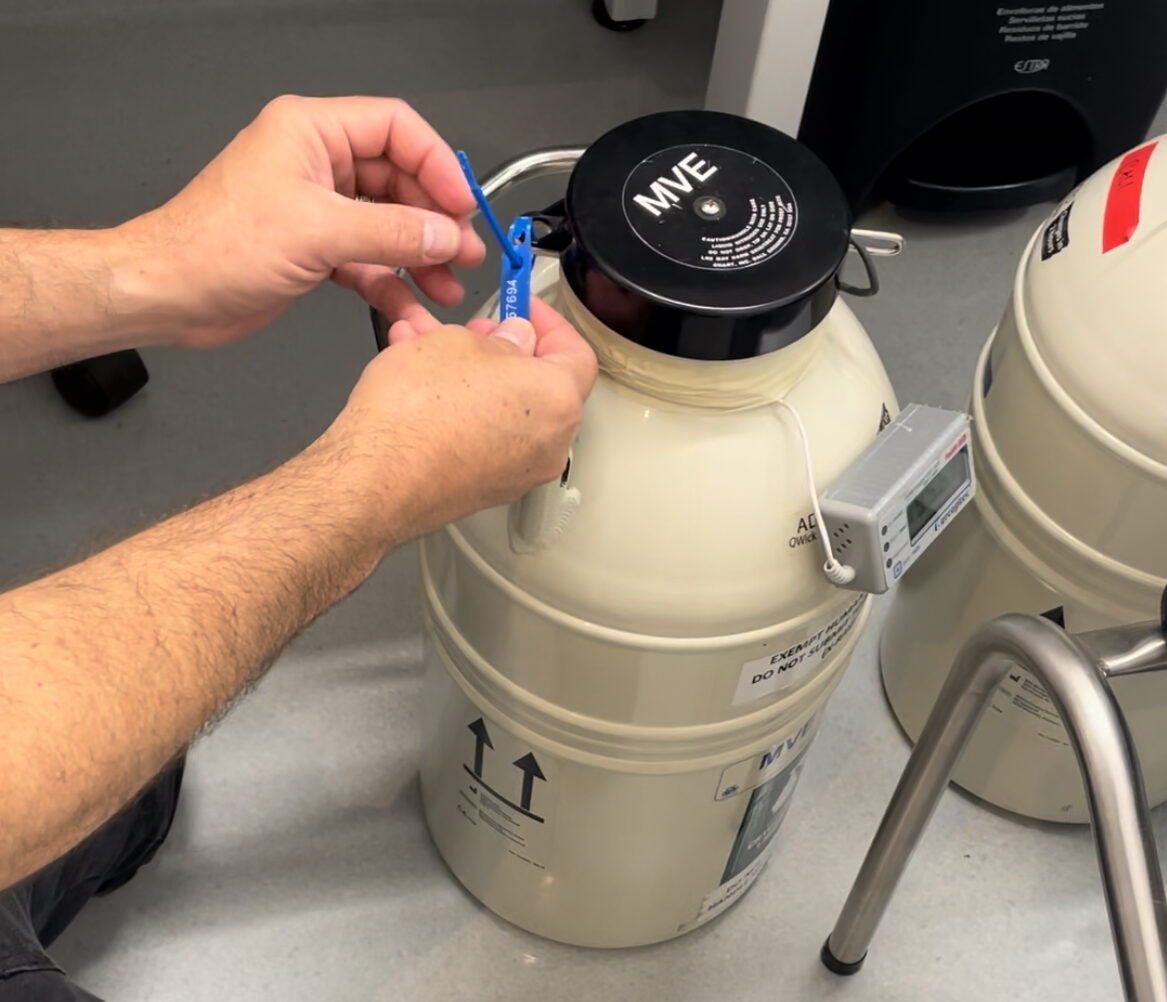
A collection record should identify the material, the equipment, the people and the conditions before the embryos leave the building. These fields form a working standard: Date and time of collection Clinic and courier identification Type and quantity of material (for example, number of canes or straws) Patient identifier, anonymized Dry shipper serial number Data logger serial number and battery status Temperature at collection (around −196 °C) Seal number Whether the courier personally witnessed the embryologist load the canister and verified the liquid nitrogen charge The last field is the one most often skipped. It matters most. A seal number proves the container was closed. A witnessed loading proves what was inside it when it was closed.
How Many Times Do Embryos Change Hands?
Every change of hands is a point where responsibility can blur, so the answer should be as small as the route allows. Here is the path in hand-carry transport:
1. Origin clinic to courier. The embryologist loads the canister, the courier witnesses it, the seal is applied and both sign.
2. Airport security. The dry shipper is never X-rayed. It goes through a manual inspection protocol with the courier present, so the container stays within the courier’s reach.
3. In-cabin flight. The dry shipper travels with the hand-carry courier (OBC) in the cabin. Custody does not pass to anyone else.
4. Arrival. The courier clears the destination airport and customs with the dry shipper in hand.
5. Destination clinic. The receiving lab inspects the seal, accepts the material and signs. The formal transfers of responsibility are few: clinic to courier, then courier to clinic. In conventional shipping, the material passes through handlers, hubs and carriers, and each one is a handoff with its own paperwork, or none. The exact count varies by route, but the pattern does not. More hands mean more places for a record to break. For a fuller comparison, see hand-carry versus freight.
What the Delivery Record Must Close
A delivery record closes the chain. Without it, the collection record is only a promise. Four items complete it:
Temperature log download. The data logger is read at the destination, in front of the receiving lab where possible.
Seal check. The receiving lab compares the seal number against the collection record.
Receiving signature. A named person at the destination clinic signs, with date and time.
Full temperature report after delivery. A complete report, not a summary line, is sent after the trip ends. The report matters because the logger holds the trip’s real history. A statement that “temperature was maintained” is an assertion. A curve is evidence. The documents for gamete and embryo transport guide covers the paperwork that sits alongside this record.
The report matters because the logger holds the trip’s real history. A statement that “temperature was maintained” is an assertion. A curve is evidence. The documents for gamete and embryo transport guide covers the paperwork that sits alongside this record.
Complete vs. Weak Chain of Custody: Side by Side
| ✓ Complete Chain of Custody (Strong) | ✕ Weak Chain of Custody |
|---|---|
| Signatures: Every handoff signed, dated, and timed | Signatures at one end only, or none |
| Temperature Data: Logger readings across the full trip | A statement that temperature was "fine" |
| Seal: Loading Report after delivery | No seal number, or never compared |
| Point of Contact: Number recorded at loading, checked at receipt | Courier receives a closed container |
| Verification: Courier witnessed the embryologist load and verify the charge | Information scattered across handlers |
| Reporting: Full temperature report sent to the clinic | Nothing sent, or only on request |
| Accountability: One identified person accountable for the record | No clear person accountable |
Red Flags When Evaluating a Transport Provider
Most weak providers reveal themselves in the way they answer, not in what they claim. Watch for these:
- No sample record available before booking
- Temperature described in words, with no logger data offered
- Seal numbers that are not recorded, or recorded only at one end
- A courier who does not witness loading
- Material routed as checked or freight items rather than in-cabin
- Any screening arrangement that involves X-ray
- Vague answers about who is responsible at each stage
- Reports “available on request” instead of delivered as standard
One red flag can be a gap in explanation. Three are a pattern.
What Questions Should You Ask Any Embryo Transport Provider?
Use these questions before signing. A rigorous provider answers them in specifics. A vague one answers in reassurance.
1. Can I see a sample chain of custody record before booking?
2. Does your courier witness the loading and the liquid nitrogen charge?
3. Which serial numbers and seal numbers are recorded, and at which points?
4. How is the dry shipper screened at airport security, and is X-ray ever involved?
5. How often does the data logger record temperature, and who downloads it at delivery?
6. Will we receive the full temperature report after delivery, and in what format?
7. Who signs for the material at each handoff, and who is accountable for the record?
8. How familiar are you with the regulatory requirements of our destination country?
How Mondo IVF Documents Each Step
Mondo IVF treats the chain of custody as the product, not an attachment to it. The material travels in-cabin with a hand-carry courier (OBC), never as checked or freight items, and is never X-rayed.
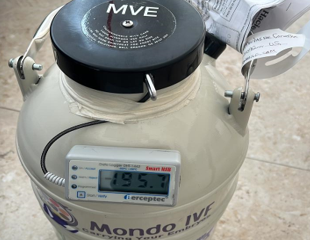
At collection, Mondo IVF records the fields listed above, including the witnessed loading and the dry shipper and data logger serials. During transit, the data logger records temperature at 20-minute intervals. The dry shipper, an MVE unit, holds cryogenic temperature for 7 to 21 days depending on its size, which leaves margin if a route is delayed.
At delivery, the temperature log is downloaded, the seal is checked and the receiving clinic signs. A full temperature report follows after each transport. Mondo IVF’s team works with IATA requirements and with COFEPRIS, ANAM and customs procedures, so documentation requirements are handled before the trip rather than discovered during it. The laws governing embryo transport explain why that groundwork matters.
Clinics evaluating partners can ask Mondo IVF for a sample record using the same eight questions above.
Frequently Asked Questions
Who keeps the chain of custody record after delivery?
Both clinics should file a complete copy with the laboratory record, and the transport provider should retain its own. Retention periods differ by country and by clinic policy, so check the requirement that applies to your lab. A record held only by the courier cannot support the lab if questions arise later.
Does a temperature report replace the signatures?
No. The two answer different questions. The data logger shows condition: what the temperature did across the trip. Signatures show custody: who was responsible at each point. A flawless temperature curve with unsigned handoffs leaves gaps in accountability. A signed record with no temperature data cannot show stability. Strong records contain both.
What should the receiving lab do if the seal number does not match?
Record the discrepancy on the receiving form the moment it is found, before the material is accepted. Then contact the courier and the origin clinic, and follow the lab’s own deviation procedure. A mismatch does not prove a problem, but an unrecorded mismatch removes any way of finding out.
What does the receiving clinic need before the courier arrives?
A copy of the collection record, the dry shipper serial number, the data logger serial number, the expected arrival window and a named contact for the handoff. With these in hand, the lab can match every identifier on arrival instead of discovering a mismatch while the courier waits.
Can patients ask to see the chain of custody record?
Yes. Patients organizing a first cross-border transport can ask their clinic and the transport provider for a copy of the collection and delivery records, including the postdelivery temperature report. A provider confident in its documentation shares a sample readily. Hesitation is useful information.
0 Comments