The Laws Governing Embryo Transport Aren’t Red Tape — They’re What Makes It Safe
Published by administrador on
The Laws Governing Embryo Transport Aren't Red Tape — They're What Makes It Safe
Ask anyone who has researched shipping embryos across a border what frustrates them most, and the answer rarely involves temperature or timing. It’s the paperwork. Import permits, customs declarations, consent forms, data-protection agreements — a stack of requirements that feels designed to slow down a process that already carries enough weight. The common assumption is simple: regulation is the obstacle standing between a family and a fast, uncomplicated transport.
That assumption gets it backwards.
Why Regulation Gets Blamed for the Delay
The frustration is understandable. A missing signature can hold a shipment at customs for hours. A permit application filed incorrectly can push a transport back by days. When something that matters this much gets stuck behind a form, it’s natural to see the form as the enemy — bureaucracy standing between intention and outcome, a system that treats reproductive material like any other package moving through an airport.
Most of the horror stories patients read online reinforce this. A shipment held at a border. A clinic scrambling for a document nobody mentioned earlier. A courier who didn’t know which permit applied to which country. These stories are real, but they usually describe a process failure, not a regulatory one. The law didn’t cause the delay. An unprepared provider did.
What These Laws Actually Do
Strip away the frustration and look at what each framework is actually built to prevent, and a different picture forms.
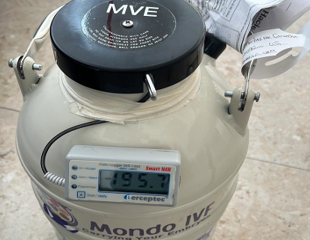
IATA — the packaging instruction governing biological substances in air transport — exists to make sure a cryogenic container survives the physical stress of a flight without failure. It sets standards for how a dry shipper must be built and packed so that a hard landing, a pressure change, or a delayed connection doesn’t compromise what’s inside. Skipping it doesn’t just risk a customs flag. It risks the shipment itself.
Country-specific import permits, like the ones Mexico’s COFEPRIS requires before reproductive material enters the country, exist to confirm that what’s arriving is legitimate, medically intended, and traceable to a real patient and a real clinic on both ends. That verification step is what keeps the system from being exploitable — and it’s also what gives a receiving clinic confidence that the shipper on their dock is exactly what the documentation says it is.
Data privacy laws — HIPAA in the United States, GDPR across the European Union, LGPD in Brazil — govern the documentation that travels alongside the physical shipment: the patient information, the clinic records, the consent forms. A courier handling that paperwork is typically classified as a Business Associate under HIPAA or a Data Operator under LGPD and GDPR, which means they carry the same breach-notification and data-protection obligations as a hospital or an insurer. That’s not incidental. It’s the legal mechanism that keeps a patient’s identity and medical history from being exposed simply because their embryos had to cross a border.
None of this is designed to slow a family down. It’s designed to make sure that when their embryos land, they’re still viable, still verifiably theirs, and still private.
What Happens When a Provider Treats Compliance as a Checkbox
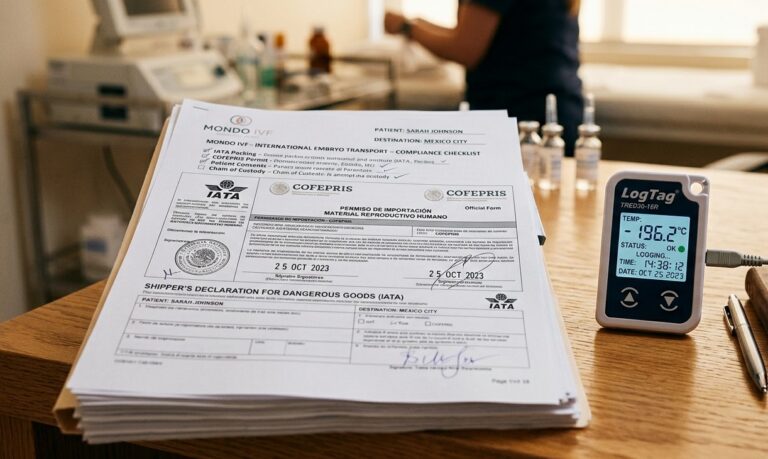
The gap shows up in practice, not in principle. A provider who treats these requirements as boxes to tick files the minimum paperwork required and moves on — until a document gets rejected at customs because it was filled out for the wrong permit type, or a consent form is missing a signature nobody flagged in advance. The regulation didn’t fail. The shortcut did.
A provider who treats compliance as protection does something different: they know which permit a specific route requires before the shipment leaves, because they’ve handled that corridor before. They document chain of custody not because a law demands a signature, but because that signed record is what lets a receiving clinic trust what arrived. Cryogenic temperature is logged at fixed intervals throughout transit, in part because regulatory standards call for it, and in part because that log is the only proof, after the fact, that nothing went wrong.
How Should a Family Tell the Difference Between These Two Providers?
Ask what happens before the shipment leaves, not just what happens during transit. A provider with route-specific regulatory experience can name the permit a given country requires and explain roughly how long it takes to secure. A provider without that experience will describe the process in general terms, because they haven’t done it enough times to know the specifics. That difference — specificity versus generality — is usually the clearest signal available before a transport ever begins.
Mondo IVF operates hand-carry embryo transport across more than 30 countries, and treats each of these frameworks — IATA, country-specific import permits like COFEPRIS in Mexico, and data-protection obligations under HIPAA, GDPR, and LGPD — as the operating standard for every route, not a formality layered on top of it. The documentation isn’t separate from the care. It’s part of how the care gets delivered intact.
Frequently Asked Questions
Why do international laws require so much documentation for embryo transport?
Each requirement addresses a specific risk: IATA regulations protect the physical integrity of the shipment during flight, country-specific import permits confirm the material is legitimate and traceable, and data privacy laws like HIPAA, GDPR, and LGPD protect the patient’s identity in the paperwork that travels alongside it. None of these exist purely for procedure’s sake.
What happens if a provider skips a required regulatory step?
Depending on the step, the consequences range from a shipment being held at customs to a permit application being rejected outright, forcing a delay while it’s corrected or refiled. In some cases, incomplete documentation can compromise a receiving clinic’s ability to verify chain of custody, which undermines confidence in the transport even if nothing physically went wrong.
How does data privacy law protect patients during embryo transport?
Under HIPAA, GDPR, and LGPD, couriers handling reproductive material documentation are typically classified as Business Associates or Data Operators, which subjects them to the same breach-notification and data-protection obligations as hospitals or clinics. This is what prevents a patient’s identity and medical history from being exposed simply because their embryos crossed a border.
Does every country require the same import permit for embryo transport?
No. Import and customs requirements vary significantly by destination — Mexico’s COFEPRIS process, for example, differs from requirements in other countries. A transport provider with experience on a specific corridor can confirm exactly which permits and documents that route requires before a shipment leaves.

0 Comments